
This is the first week of book release events for the Mwandishi band book. Tomorrow, Tuesday morning, I’ll be on Joe Donahue’s radio interview show on WAMC, Northeast Public Radio. You can listen shortly after 11am on streaming audio on the WAMC website. On Thursday night September 13, 7pm, I’ll be giving a talk at The Book House, Stuyvesant Plaza, in Albany, NY; and on Saturday at 5, I’ll be at the Chatham Bookstore, Chatham, NY. That one will include me playing some musical examples at the piano. The next round will be two Saturday trio (or possibly quartet) concerts, Oct. 20 at 2pm, in Mt. Kisco, NY; Oct. 27 at 5pm, in Woodstock, NY. Woodstock will include a book talk and concert. On Friday, Nov. 2, at noon, I’ll be at the 92YTribeca in NYC. You can find all the info at http://www.electricsongs.com/shows.html. Hope to see you at one or more of these. More events will be announced in the near future.
“Herbie Hancock and the Mwandishi Band” – The book talks begin
•September 10, 2012 • Leave a CommentDonal Henahan and Electric Ear, hats off to constructive critical writing
•August 22, 2012 • Leave a CommentNew York Times reported this week that their longtime music critic Donal Henahan died this past Sunday, August 19, 2012. Writing in the Times from 1967-1991, Henahan was one of the first in the mainstream press to really comprehend the new musical environment of the late 1960s and appreciate shifts in aesthetics and venues. Soon after the opening of the Electric Circus discotheque in 1967, founding artistic director composer Morton Subotnick collaborated (with Thais Lathem) in the establishment of the venue’s Monday night New Music series, Electric Ear. This was one of the first such series in New York; from it sprung forth successors Intermedia at Automation House, the WBAI Free Music Store (thanks to Eric Salzman), and others. Salzman and Lathem met working on New Images of Sound, a parallel series at Hunter College.
Henahan wrote in the Times: “The composers who presented their experimental works at the Electric Circus on Saint Mark’s Place during this summer’s Electric Ear series – a series one devoutly hopes will not be allowed to die … About half the time, they bored infuriated or depressed us, too, but if experimental art succeeded in giving pleasure all the time, it would not be necessary to call it experimental, would it? Although their efforts to amuse and edify varied widely in intent, quality, exploitation of the hall’s technical resources and sheer ambition, one could feel tremors of sympathetic connection … What the farthest-out composers seem to be working toward these days is an inwardly turned kind of music-drama, a Theater of the Mind, if you will, in which sounds, lights, movement and a few minimal, suggestive props are used to encourage the spectator to play out some essentially unstageable, poetic experience on a stage erected in his head.” (“Too Soon To Demand a ‘War and Peace’,” New York Times, Sunday, September 15, 1968)
In his review, Henahan offered this global statement that could stand as a guiding principle for all times: “Every generation must rediscover its own revolutionary truths, and something oddly different is being heard in certain experimental works … Music, and perhaps any art, the composers seem to be saying, is an allusive, never a specific way of addressing the human mind, a magical way of inventing a kind of reality out of the universe’s chaos …”
In a similar vein, Henahan wrote two months earlier about the founding of the series. He declared that increasing numbers of modern composers, facing a “dead end at which our opera houses and concert halls seem to be arriving”, “are abandoning the relatively recent European tradition of the artist as anti-popular prophet for the more ancient conception of the artist as a man deeply involved in contemporary society.” (New York Times, Sunday, July 7, 1968)
The Electric Ear series actually began in 1967. That winter, Thais Latham teamed up with NYU Psychology professor Ted Coons in the planning of the first of two multimedia events that showcased the kind of production in the spirit of Electric Ear but on a much bigger scale. “An Electric Christmas” took place Tuesday evening, Dec. 26, and Saturday evening, Dec. 30, 1967. It included music by Mort Subotnick, liquid lights by Anthony Martin (Subotnick’s collaborator at the San Francisco Tape Music Center, in the Intermedia Program at NYU, and at the Electric Circus), the rock band Circus Maximus (including Jerry Jeff Walker), and an early music ensemble Music Pro Musica (conducted by John White, a friend of Coons). Coons had dropped in at the Electric Circus unannounced and pitched the idea to Electric Circus manager Denis Wright. Coons remembers: “John White called up Carnegie Hall, because Pro Musica was scheduled to give a Christmas concert there. He said: ‘You know, we are going to have something at the Circus, perhaps this is a conflict of interest as far as you are concerned.’ Shultz, the person in charge at that point, said: “On the contrary, we’ll just change the program. We’ll invite the whole thing up to Carnegie Hall.” The show was credited in the program as follows: “Conceived and Performed by: Morton Subotnick, assisted by Richard Friedman and Michael Czajkoski, with light show conceived by: Anthony Martin, performed by: Anthony Martin, Michael Malone, Bill Sward, and Jane Abelman. Consulting Psychologist: Dr. Edgar E. Coons.”
Of course Donal Henahan was there for the show. And his review was prescient in his understanding, as his writing about Electric Ear would show, the following year. “An Electric Christmas,” as the enterprise was entitled, did prove to be an interesting experiment. It demonstrated to a large commercial audience that the compartmentalization of art and entertainment, sanctified by the 19th century, is in all likelihood a dead issue in 1967… the night summed up most of the esthetic ideas now in the air: incongruity, simultaneity, games theory, the put-on, the parody, the Trip, the styles happily co-existing in art today and the effort to create a “total environment” in which all the senses can come into play. Not at all surprisingly, there was a program credit for a Consulting Psychologist: Dr. Edgar E. Coons.” (New York Times, December 27. 1967).
Henahan’s obituary in The New York Times quoted his first published Times review, of a concert by Ravi Shankar. There, he noted: “The American subculture of buttons and beards, poster art and pot, sandals and oddly shaped spectacles met the rather more ancient culture of India last evening at Philharmonic Hall.” (September 14, 1967) Let’s hear it for writing that takes a broad cultural perspective, is enjoyable to read, and treats criticism as a means of bringing the reader closer to understanding music, rather than as competitive sport.
I write further about the Electric Circus, Electric Ear, Mort Subotnick’s work in late 1960s New York City, and related topics in my recent articles: “Electric Circus, Electric Ear and the Intermedia Center in Late-1960s New York.” Leonardo 45:1, MIT Press. Winter 2012; and “Nurturing Young Composers: Morton Subotnick’s Late-1960s Studio in New York City.” Computer Music Journal, 36:1, Spring 2012. The Circus and Electric Ear form the core of a chapter in my book in progress: “Gestures, textures, open spaces: Chick Corea’s Circle, new creative venues and openings to the musical 1970s.”
You can find the Times obituary for Donal Henahan here: http://www.nytimes.com/2012/08/21/arts/music/donal-henahan-a-music-critic-for-the-times-dies-at-91.html?_r=1&ref=obituaries
“Herbie Hancock and the Mwandishi Band” – Bob Gluck’s new book
•July 26, 2012 • 2 Comments
Bob Gluck holding a first copy of “You’ll Know When You Get There: Herbie Hancock and the Mwandishi Band”
Info: http://press.uchicago.edu/ucp/books/book/chicago/Y/bo10327415.html
The Moog synthesizer’s inaugural public performance… with Hank Jones or Herbie Hancock?
•May 4, 2012 • 2 CommentsHerbie Hancock is for good reason well known as an early adopter of new technologies. His fascination with electronics dates at least as far back as college and his interests specifically in electronic music begins early in his time with the Miles Davis Quintet. Some of the poignant moments in his recording career represent moments when he was experiencing a new instrument for the first time. Two of these are his Fender Rhodes electronic piano playing on the tune ‘Stuff’ on the Miles Davis Quintet’s album “Miles in the Sky” and his Farfisa electric organ solo on ‘Right Off’ from Miles Davis’s “A Tribute to Jack Johnson.” I write about each of these moments in “You’ll Know When You Get There: Herbie Hancock and Mwandishi Band,” coming in August on University of Chicago Press.
Herbie Hancock’s first exposure to synthesizers, however, was not actually playing one, but rather, witnessing what turned out to be Patrick Gleeson’s work on two tracks from “Crossings,” the second Mwandishi band record. The story of that encounter was sparked by producer David Rubinson’s suggestion that Hancock visit Gleeson’s studio if he wanted to learn about synthesizers. The demonstration could have moved him to begin playing synthesizer, but Hancock was so enthralled with Gleeson’s creative interpolations within the band’s completed studio tracks, leading to Gleeson’s joining the band. Herbie Hancock’s beginnings as a synthesizer player are first on display on the post-Mwandishi recording “Head Hunters.” And all the rest is history.
I recently discovered that there was a prequel to Herbie Hancock’s “life with synthesizers.” This dates back to August 1969, during the touring period of the Herbie Hancock Sextet, prior to its reorganization as the Mwandishi band. This was the period between the recording of the two 1969 albums under his name, “The Prisoner” and “Fat Albert Rotunda.” But the story unfolds in an unexpected direction.
The setting was a concert that provided the public unveiling of the Moog synthesizer as a live performance keyboard instrument. It took place in New York City, before a large, excited crowd. The August 28, 1969 concert was the finale in a summer series, “Jazz in the Garden,” performed outdoors in the Museum of Modern Art’s Sculpture Garden. The all-electronic concert showcased four small-scale Moog systems, all keyboard instruments, one emulating bass and vocal sounds, a percussion synthesizer, a complex system with presets allowing relatively rapid access to a multiplicity of sound options, and a fourth with a polyphonic keyboard, suited for a skilled pianist who could both solo and comp. Pianist Chris Swanson, who had already been performing Bach and, later, jazz concerts on the Moog, fronted a group that included a then relatively unknown guitarist, John McLaughlin, pianist Hal Galper, and drummer Bob Moses.
A second quartet was fronted by Moog’s associate Herb Deutsch. The pianist who played the polyphonic Moog was the acclaimed Hank Jones. But Jones was not Deutsch’s first choice; Herbie Hancock was. Hancock modestly declined the invitation with a fascinating rationale, as Herb Deutsch later recalled: “I don’t remember his exact words, but he felt that at the time, synthesizers and electronic music were things he didn’t know enough about (pretty amazing considering where he went within 4 years of that concert!!). It was Herbie who suggested that Hank Jones might be interested, and it was really an honor to get to know Hank.” The concert was a great success, despite an abrupt interruption near the end, when someone inadvertently pulled the power plug for the multi-keyboard set-up and sound system. Critic Bertram Stanleigh wrote of the concert: “These were real musicians playing real music, and it was clear that their message was getting to the audience.” I wonder how history might have gone differently had Herbie Hancock said “yes” to Bob Moog’s August 1969 invitation. It is very difficult to complain about what did in fact unfold: “Crossings,” “Sextant,” “The Spook Who Sat By the Door” soundtrack and the Mwandishi touring band with Patrick Gleeson – and the ability of Herbie Hancock to experience yet another “first time” to inaugurate the Headhunters band era.
A fascinating post-script: after the concert, R.A. Moog sold one of the Moog systems from the concert through its English distributor. It was purchased on behalf of a British rock keyboardist who was about to record his new band’s soon to be hit single, “Lucky Man.” The distinctive solo, known for its slow portamento (pitch slide) was performed on the newly purchased Moog (another “first” encounter creative moment) by, of course, Keith Emerson. And the band was recording its first, eponymous titled album, “Emerson, Lake and Palmer.”
“Herbie Hancock and the Mwandishi Band” – new book on its way
•April 2, 2012 • Leave a Commenthttp://press.uchicago.edu/ucp/books/book/chicago/Y/bo10327415.html
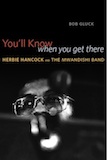
“You’ll Know When You Get There: Herbie Hancock and the Mwandishi Band” is now in production, set for a summer release on University of Chicago Press. I’ll post more information about the release date and book roll out in the coming weeks. The cover art is done. The first few quotations that will go on the rear jacket have been coming in, with the rest due within a few weeks. It’s happening!
You can find a preliminary catalog listing here:
.
“Herbie Hancock and the Mwandishi Band” – Did you realize how interesting a book index really is?
•March 2, 2012 • 2 CommentsAs the publication date approaches (this July!) for “You’ll Known When You Get There: Herbie Hancock and the Mwandishi Band,” I’m completing the last parts of this project that remain in my hands. They are two in number: crafting the index and doing a final proofread. The production staff at University of Chicago Press has done a great job at book layout design (it looks really beautiful), and writing the preliminary marketing copy… and the cover art should be ready in a few weeks.
Looking back over the past couple of years, it is the idea of indexing that has been the angst-filled for me. As it turned out, creating it was quite engaging and interesting. The task was an occasion to revisit my original thinking regarding what the book is really about. And it allowed me to reconsider its navigability — what are the various ways I’d like people to be able to use it, based on their interests? About four months ago, I created a preliminary document laying out key words – these included names of people, musical ideas, culture/political concepts, and so on.
To give you a picture of this, here is the opening list of terms and names on the first page of the index.
abstraction
afrocentric
Arp 2600
Arp Pro-Soloist
Areas, José Chepitó
Art Ensemble of Chicago
Association for the Advancement of Creative Musicians (AACM)
avant-garde
Barker, Thurman
Berkeley (California)
Bitches Brew (1970)
black cultural identification and representation
You are right–none of the musicians who played in the band appear in this list (well, none of their names start with the letter A: Hancock, Gleeson, Hart, Henderson, Maupin, Priester, Williams, plus sound engineer Fundi). To find them, you have to turn a few pages and there you’d begin to come upon names of musicians, names of recordings, tunes, and so on.
So consider what you can learn from this list. One thing that you can see is that the index contains quite a variety of topics: musical/aesthetic concepts (abstraction, avant-garde), cultural/political ideas (afrocentric, black cultural…), people who performed on the recordings: percussionist José Chepitó Areas), musicians who have reminiscences of experiencing performances times with members of the band (Thurman Barker…), electronic musical instruments (Arp 2600, Arp Pro-Soloist…), musical collectives (AACM), places where the band performed (clubs in Berkeley…), non-Mwandishi recordings that provide reference points for discussion (Miles Davis’s Bitches Brew…)… you get the picture.
So, crafting the sixteen page Word document has proven really interesting. Ok, tedious, too. But few things worth doing come without some hard work. Isn’t this the case. And now I can move on to the final round proofreading. I’m getting another step closer to the conclusion of this nearly five-year project. Or at least to it’s next stage, the life of the book out in the world.
BAM and pride in our music
•February 20, 2012 • 2 CommentsI just returned home from attending, presenting and performing at the International Society For Improvised Music (ISIM) conference. The events took place this year at William Patterson University in New Jersey. This was my first contact with the organization and I enjoyed the conference quite a lot. During a panel discussion on the theme of diversity, the moderator raised a question discussed recently by Nicholas Payton – should the term “jazz” be replaced by “Black American Music” (BAM)? By my placing “jazz” in quotation marks, as I often do, you can guess where I stand on this (I’m sympathetic) – and yes, it is a complicated issue, but one at very least worth dialoging about.
I find the term “jazz”, like most if not all genre-related words, to be unhelpful, confining, and at times stigmatizing. Here is an example of the latter problem: in music classes, I periodically write a series of names on the board and ask people to categorize each person as either a “jazz musician” or a “composer.” Ok, it is a set-up. The list often includes Ornette Coleman, Ludwig van Beethoven, Anthony Braxton, Karlheinz Stockhausen, Duke Ellington, and John Cage. You can imagine how this goes and the point should be obvious. But embedded in peoples reasoning, beyond the most superficial, is a cultural assumption that uses the term “jazz” as a racially based association. The thinking goes like this: of course Duke Ellington was a composer, but if names like Cage and Beethoven are in the mix, racially centered categorization comes into play. It seems to me that if people have to choose whether to place Ornette Coleman in the same bin as Beethoven (although both were/are great improvisers as well as composers of through-composed instrumental music), somehow the weighing process shifts OC into the other bin. Is this a meaningful way to think of music?*
With this said, I have found the term “jazz” to be strategically useful. This is in the same way that I have found the term “electronic music” to be useful. By strategic, I mean that these terms have helped me legitimate music with my academic colleagues — and family members – who (in both cases) privilege “classical” music as the cultural norm and the bar against which other forms are to be judged. I once proposed the term “creative music” for the music major concentration that I supervise at my school. That went over poorly, as if I were suggesting that the performance of European Art music was inherently not creative; which was not my point at all. But it has become increasingly difficult for academics in music to de-legitimate jazz as an authentic musical tradition, and thus the term becomes useful. Instead of saying “music that isn’t classical” or “music whose roots are in African American culture.” By the way, calling my music “jazz” positions it to be appropriate for jazz clubs. All of which brings us to the BAM question.
At the conference, I responded to a comment (made by several people) that sound is without color. Of course, this is theoretically true. Yet I was reminded of George Lewis’s observation (particularly in his 1996 essay “Improvised Music After 1950”) that the construction of musical categories is anything but colorblind. Lewis’s specific point was that unless people specifically invoke black music, the term “experimental music” is thought to imply European traditions. He makes the case for music of AACM members (Association For the Advancement of Creative Musicians, a collective organization founded by black musicians in Chicago in 1965) as embodying everything implied by the term “experimental.” The bottom line is that within American culture, universals translate into “white” or “European.” Black is a special case that is invoked by using terms that reference black music, like the term “jazz.” “Jazz” suggests, like in the case of Ornette Coleman, something other than the musical norm in this culture, even regarding experimental music. Coleman becomes at best a special case of composer, if not one of questionable legitimacy. Because we all know that he is “really” a jazz musician or, in other words, he is a “black” musician first and a composer second (if that).
What George Lewis was really saying, and what I pointed out during the panel discussion, is that any culture can provide a container for any and all musical forms. But the “wallpaper” (ie. the stated cultural context) is critically important if distinct cultures–like African American culture–are to be treated with full respect and legitimacy. I feel the same way about my own Jewish culture. When the “wallpaper” is unspoken or thought of as universal (ie. “music has no color”), the presumption is that the context is the broader, ie. “white” American culture. When the “wallpaper” is articulated as being “black,” lots of people become very uncomfortable and insist on reminding us: “music has no color.” Yes, music has no color, but music is a form of cultural expression; it is not universal, it is culture-bound. This is the point I’ve been making for years about the value of understanding electronic music no differently from all other musical traditions, as a set of culturally rooted and diverse, rather than strictly European-grounded—as is usually said–traditions.
At the conference, I performed a series of duets (with Jane Ira Bloom). The cultural framework for these pieces is Jewish; they reference traditions of Jewish biblical cantillation. The approach is multi-layering monophonic lines, without evoking harmony. This is rooted in Jewish musical history, but my second of two sources for this is, you guessed it, Ornette Coleman’s harmolodic approach. “Tropelets” could be considered, in essence, equally black music and Jewish music. It has moorings in both cultural traditions. Is it “just” sound? In a sense yes, but I would deny that this is a meaningful way of describing human expression since we are all grounded in culture. There is no way to (literally) speak in a universal language; just try it!
If any musical form can exist within any music-cultural framework, is there any reason to not identify that framework as black? Why not acknowledge that jazz, rooted in African American cultural history and aesthetics, is black music—and do so as a source of pride, whether one is oneself black or white? Well, it seems to make many people very uncomfortable. But why not simply acknowledge this discomfort? It is an artifact of an American cultural that stigmatizes black culture. Now, I know that there have been many white “jazz” musicians who have felt excluded and under-appreciated, maybe due to their race. I personally know that feeling. I also know that there are ways in which I, like other white musicians, have tremendous privilege, including musical opportunities and remuneration. There is too much history that places race as a core way our society understands itself. So why not simply say: “I am a musician; I am white, I am proud to play music that is simultaneously rooted in black culture while evoking all that I am as a human being. Saying this makes me uncomfortable. Now let’s talk about it openly.”
——–
* Well… not entirely meaningless in the sense that the term “jazz” evokes traditions that are associated historically with, well, that lineage of Louis Armstrong, Bud Powell, Charlie Parker… But the move in recent years to sculpt a jazz “canon” has, as others before me have suggested, skewed an accurate profile of the nature of this tradition. Such is the way of most moves towards canonization. When Ornette Coleman received a scant five minutes, tops, in Ken Burns’s jazz television series, that said it all to me; viewing his work as a sideline if not distraction, in the evolution of jazz (as opposed to one of the most important developments of all music in the 20th century).
Paul Bley… the synthesizer show and his place in history
•January 21, 2012 • Leave a CommentAs I continue to work on my second book, focused on 1970-71, Paul Bley’s synthesizer show (1970-72) has been on my mind. I just spoke about it with Barry Altschul, drummer in the 1972 edition (and who first played with Bley in the 60s). I’ve been listening to Bley’s two synthesizer recordings this week, and I’m also awaiting responses to some questions I posed to him.
I’ve thought about Paul Bley on a few occasions during the past three years, in part because several of the reviews about my CDs have referenced him as an influence; most often mentioned is Bley, Don Pullen, and Cecil Taylor. Ironically, while Pullen and Taylor have indeed been direct influences, the only recording by Bley that I had ever heard until last month was his early ‘70s ECM solo record. Returning to that record now, in the context of some of his trio recordings, I’m struck by what a pioneering influence Bley was on many others, particularly in the generation of Keith Jarrett, Chick Corea, and Pat Metheny, to name a few. These are the ones (plus Herbie Hancock, Art Tatum, and Keith Emerson) I started listening to late in high school and during college. What I now see is that although I may not have been directly influenced by Paul Bley, I was in fact listening, on a regular basis, to multiple refractions of Bley. It was like the wallpaper, just as Bud Powell’s influence was impressed on me swell before I actually heard him play.
Bley’s synthesizer recorded playing, on an Arp (one of the instruments I knew well in the mid-70s), was unlike anybody else. In fact, when he began, there was really nobody to imitate. When he received his first Moog, the idea of the system being a keyboard performance instrument was new. When Bley began working with synthesizers, first in public in 1969, his approach was different in kind from the others who began playing the Moog: most notably Richard Teitelbaum, Wendy Carlos, and Keith Emerson. Sun Ra started playing a synthesizer whose sounds were largely determined by the manufacturer, the Mini-Moog, in 1970; his performances with the Clavioline (1947), and the pre-Fender Rhodes electric piano (1954), were highly imaginative and unprecedented. Listening closely to Bley’s work, one hears a keyboard transformed into a sometimes microtonal, atonal, and portamento-filled instrument (in part, think Ornette Coleman), and other times simply funky and rocking. In both cases, comparisons with Corea’s and Metheny’s subsequent choice of synthesizer sounds and articulations are gain a context.
More broadly, Bley was way out front, back in the mid-1950s, when he considered how one could improvise freely, without chord changes, treating chords in a non-harmonic manner. It was Bley who hired a young new bassist, Charlie Haden, for an extended gig during that period, at the Hillcrest Lounge in Los Angeles. Haden brought along his friend, Don Cherry, and tagging along with Cherry was his friend… Ornette Coleman. The band that formed, with Billy Higgins on drums, soon moved to New York without Bley, to become Ornette’s famous quartet that shook the New York jazz world, while at the Five Spot. The rest is history. This is not at all to say that Ornette wouldn’t have happened without the Hillcrest; he was already very much happening, but things might well have played out differently. Ornette had, of course, already recorded his first record, with Don Cherry and Billy Higgins (Something Else!) and he was becoming known among musicians around Los Angeles.
Bley’s place in the history of open improvisation, and why he seems so rarely mentioned in jazz histories is something I will be taking up in my second book. I have ideas about that, which I’m in the process of exploring, as I consider the alternately interconnected and parallel musical worlds within New York City during Bley’s synthesizer band period. I’d certainly like to hear your ideas… feel free to comment here or write.
Herbie & Miles… Bridging the two projects
•December 19, 2011 • Leave a CommentThere are two main themes that bring together my forthcoming Herbie Hancock/Mwandishi band book with the new project about 1970/71 New York: musical boundary crossing and a search through and beyond the music for personal identity and one’s place within broader society. These themes played out in the emergence of bands and musicians who refused to have time for time-honored lines between forms of music.
Anthony Braxton, playing solo and in his own ensembles, as well as with the band Circle, saw every reason to bring to bear every resource he could muster from the European and American avant-garde, alongside Charlie Parker, new developments emerging within the AACM, the lessons of Ornette Coleman, and on and on. For Chick Corea, whom Anthony Braxton joined in forming Circle, angular abstractions, Impressionist lyricism, and Bartokian modes and dissonant intervals were all part of a unified sonic pallet. Herbie Hancock saw no meaningful lines to respect dividing the “controlled freedom” to which he contributed within the Miles Davis Quintet, from elements of rhythm and blues, the aesthetics and techniques of electronic music he heard in college and in the early 60s, to name a few. Tony Williams, Miles Davis, John McLaughlin and others, bridged the rhythms, sonic values, and other elements of rock and jazz, Indian and other musical forms. I could go on and on. For some, the music was suffused with indicators of black cultural identity, but even there, the musical elements drew from multiple roots. Why not simply be whom ever one was, grounding oneself where one most deeply identified. Yet, from within that place build a personal form of expression using everything available from our broad and shared American cultural heritage?
The connection is also personal: 1970/71 was my musically breathless sophomore year in high school that opened many doors; having discovered Jimi Hendrix the previous year, I left Julliard, saw Emerson, Lake and Palmer at one of many concerts I attended at the Fillmore East, experienced the death of Hendrix, joined a rock band with a horn section, discovered John Cage and Karlheinz Stockhausen, heard Bitches Brew, saw Herbie Hancock’s Sextet in transition to Mwandishi, traveled to London and heard King Crimson perform at Watford Town Hall, and then took a year’s break from playing the piano. Much of this is now a blur of images in my mind.
Three years later, now in college and back at the piano, I first heard Anthony Braxton, Weather Report, Chick Corea’s band Return to Forever, through which I discovered Circle, discovered the loft scene in Soho and the Village, began to compose electronic music, heard the Mwandishi band and early Mort Subotnick records, formed my own band building upon what I loved about Circle, played in a live electronic ensemble… and we’re off and running, well, with a delay of a few decades.
 Bob Gluck's Blog