Conversations with drummers – Warren Smith, Barry Altschul, Alvin Fielder, Jerome Cooper – and reflections about Jack DeJohnette

•December 4, 2025 • Leave a Comment

As a writer and pianist/keyboardist, drummers have always been important to me. One of my longest running musical partnerships has been with drummer Tani Tabbal (who appears most recently on my album “Early Morning Star” (2020, FMR). Another highlight was the time I spent speaking and playing with Billy Hart (the fruits of which include the album “Infinite Spirit, Revisiting Music of the Mwandishi Band” (2016, FMR) and interviews that appear within my book “You’ll Know When You Get There: Herbie Hancock and the Mwandishi Band (University of Chicago Press, 2016). You can find information about all of these projects at electricsongs.com.

A few years ago, I published in my WordPress blog an interview with the late drummer Alvin Fielder. Recently, I’ve begun to post additional interviews on my Substack “Music and Our Lives”

Warren Smith

The most recent addition is a conversation with the remarkable percussionist, educator, organizer Warren Smith. The initial interview took place in 2011, but has been updated with further conversation, most recently on December 1, 2025. We discuss his early life in and around Chicago, his eclectic performing career – from Broadway to Max Roach’s M’Boom percussion ensemble, to Tony Williams Lifetime… his teaching career and his involvement in the NYC Downtown jazz loft world. His work continues now in his 9th decade. He is just a pleasure to speak with and I think you’ll enjoy reading the text.

Barry Altschul and Jerome Cooper

Also this year, I’ve posted on Substack an interview with drummers Barry Altschul, the late Jerome Cooper (an earlier version of which is also on the WordPress blog you are now reading.

Jabali Billy Hart as an exemplar of what I admire so much about drummers – and a note about his new album

What I have personally loved most about fine drummers is how the best of them combine a wealth of historical knowledge and a broad perspective on the music they are playing. Their fine technical skills go without saying. Jabali Billy Hart one told me that he thinks of his role as composing at the drums, no matter what the music may be. This implies an awareness of everything that is happening at any given moment during a performance. This was certainly my own experience playing with him. With the recent passing of Jack DeJohnette, and a year ago Roy Haynes, Hart now essentially stands alone among the distinctive drummers of his generation, the ones who learned from Elvin Jones, Max Roach, Art Blakey, Tony Williams… and who have thus defined jazz drumming in the generation that came of age in the 1960s.

And Billy Hart continues to inspire. The latest album of his stellar quartet was just released: “Multidirectional” (a term he uses, borrowing from John Coltrane, for his aesthetically expansive approach to the drums). Learn more here about the album and about the club whose label released it, Smoke, on the Upper West Side of Manhattan.

For me, drummers keep the world spinning round and there have been fewer the equal of Billy Hart. I will have more to say about him in the future.

Remembering Jack DeJohnette

I posted a few reflections about Jack DeJohnette on my Substack a few days following his death.

The economics of jazz and the broader music economy – the important role of the government

•June 19, 2025 • Leave a Comment

I’ve been posting in my substack “Music and Our Lives” a three-part series on this important topic, which includes:

NYC Council and Federal small business support in the recovery from the devastation of jazz clubs during the COVID 19 pandemic,

the historical role of the National Endowment for the Arts (NEA), National Endowment for the Humanities (NEH), Small Business Administration… in supporting Arts in the United States,

the good and the bad in the use of artists in State Department endeavors,

What may the future hold?

Parts one and two are already posted, with part three coming soon.

Part 1: What happened to the jazz economy in New York City during the pandemic and why does it matter now?

Part 2: Federal funding and the music and Arts economy 

Part 3: Further thoughts about Federal funding of jazz and other musical arts – tours & the Internet

Six years in the life of a concert setlist devoted to performing music by Pat Metheny

•June 7, 2025 • 1 Comment

There’s an interesting story to how studio sessions, concerts, a recording, and the writing and publication of a book have shaped performances of Pat Metheny’s music by the trio Transcendence

This is a story of a set list. A set list is the order of compositions to be played in a concert. At some concerts, audiences may have in hand a printed list, although that’s a practice in only some kinds of musical settings. In most, the performers have a copy of the list taped to an instrument or speaker cabinet. The performers in Transcendence are Bob Gluck (keyboards), Christopher Dean Sullivan (bass), and Karl Latham (drums). Our new album, Transcendence Plays Music of Pat Metheny (FMR Records) can be found on BandCamp and, starting July 1, on streaming platforms. Another version of this essay can be found on my Substack blog, Music and Our Lives.

I have spent a fair bit of time designing set lists, often going back and forth about what it might include. Sometimes, there’s a theme. For me, this is most often the case only following the release of a book or recording, the theme is set, and the question is how much of the show should be devoted to that repertoire, and then, which compositions and in what order.

Following the release of my book Pat Metheny, Stories beyond Words (University of Chicago Press, August 2024), my thinking about how to design sets of his music has been guided by a combination of what the band and I have enjoyed playing, and whether there are notable musical ideas within compositions that could be exemplified in performance. Finally, of course, comes the question of the order of the pieces within the set, and with that, many of the kinds of factors that most musicians who construct set lists think about. Are there groupings or combinations of compositions that might form an interesting “sub-set” or suite, is there variety in mood, energy levels, tempo, types of feels and such things? Often, the answers can be quite intuitive. Also, building set lists on the same theme or repertoire can, over time, take on a certain momentum of its own.

It wasn’t part of my plan to become engaged in a Pat Metheny themed project or, rather, projects. What initiated all of it was an unexpected event in late March 2019, six years ago. One evening, I was chatting with Metheny following a Side-Eye trio concert. Some of you will respond to what I’m about to say with “Bob, really?” but at a certain point, I told him that it was getting late for me, so I’d better head home.” As we saif goodnight, he paused, and said “wait a minute,” looked around, and handed me a copy of his newest “Songbook.” This initiated a really interesting, albeit unanticipated six-year ride. Back in March 2019, I had no idea that any kind of projects might unfold. I was working diligently on other things at the time and I didn’t yet know that some of them would go on pause, stop, or morph due to the coming pandemic.

Meanwhile, I was rehearsing my own music, preparing to record what became the album, Early Morning Star. When I took a break from working on that, I would played my way through the Metheny Songbook, one or two tunes at a time.

By late summer 2019, I had chosen 25 Metheny tunes that most interested me as a performer. Many of them required serious translation for piano and bass, and then a piano, bass, and drums trio. I invited my longtime bassist compatriot Christopher Dean Sullivan to play a duo show at my university. I realized that my list of 25 needed to be cut to 15 (or so). We rehearsed a few of that final 15 in mid-November and played the show in late January 2020. That date tells you something about where this is heading.

Planned concerts on two other projects were cancelled for that Spring. My new album, Early Morning Star (with Andrea Wolper, Kinan Azmeh, Ken Filiano, and Tani Tabbal) was released by FMR Records on June 15, 2020, so much of it would never be performed in front of an audience or not with all the same band members. Somehow, performances with the Metheny repertoire continued through the end of 2020.

Here’s what the January 28, 2020, piano-bass duet setlist looked like:

Are You Going With Me (Metheny)

80/81 (Metheny)

Offramp (Mays and Metheny)

Always and Forever (Metheny)

Afternoon (Metheny)

Back Arm and Blackcharge (Metheny)

The Bat (Metheny)

Roof Dogs (Metheny)

Another Life (Metheny)

Dream of the Return (Metheny)

Half Life of Absolution (Metheny and Mays)

Farmer’s Trust (Metheny)

Question and Answer (Metheny)

James (Metheny)

The hour and a half set included fourteen compositions, leaving out two that had been rehearsed, Everything is Explained, from Pat Metheny’s newly released album, From This Place, and the one non-Metheny piece, Herbie Hancock’s I Have a Dream. A few months later, I’d ask Pat to send me the score to the complex opening piece, America Undefined, from his new album. This became my entry point for the book.

I had already accepted an outdoor show for September 3, 2020. Chris recommended Karl Latham to join as drummer to make it a trio. This proved to be an excellent choice. Chris and I had one socially distanced rehearsal in early June. I started to make video recordings of some of the music played solo, a month later, and in late August, the trio gathered at Karl’s studio for the only trio rehearsal we’ve ever had. The chemistry was immediately apparent and playing the music, some of it quite challenging, came naturally and with enormous spontaneity.

During this period, the “staples” Chris and I worked on were the upbeat Afternoon, the ballad The Bat, and the driving Question and Answer. The latter was a tune that Metheny first recorded with a trio, so we knew it could be a great vehicle for us. I added one more non-Metheny tune, Keith Jarrett’s beautiful Everything that Lives Laments, from his “American Quartet” of the 1970s. Now, with the addition of Karl, we went more intensely at some of the fierier works within Metheny’s repertoire, Half Life of Absolution, Offramp (each composed by Metheny and Lyle Mays), and Roof Dogs (from Pat Metheny’s Unity Band).

Here is the set list from early September 2020 trio show. Note that we never rehearsed most of these tunes as a trio, although Chris and I had played them as a duo several months prior. This netted five ballads, two “medium” tempo, four up tempo, and then Half Life of Absolution. The latter was the toughie, a wonderful suite of changing moods, wailing melodies, rich harmonic changes, and long periods of relative stasis. To say the least, this was an eclectic Metheny set list.

*Farmer’s Trust (Metheny)

+Afternoon (Metheny)

+Are You Going with Me (Metheny)

*Everything that Lives Laments (Jarrett)

Offramp (Mays and Metheny)

*Always and Forever (Metheny)

*Another Life (Metheny)

Roof Dogs (Metheny)

*The Bat (Metheny)

80/81 (Metheny)

Half Life of Absolution (Metheny and Mays)

Question & Answer (Metheny)

This list may look long, but it didn’t even include everything I initially imagined including. There were four more charts in the wings, widely ranging Metheny tunes: the ballads New Year and Dream of the Return, plus Counting Texas and the hands-bending Back Arm and Blackcharge. The set should have put to rest anyone’s generalizations about Pat Metheny’s body of work. Yes, melodious; yes harmonically rich; and also yes at times aesthetically close to Ornette Coleman; yes, yes, and yes, and yes.

We subsequently decided to continue working together, with social distancing. Karl had started a weekly live stream series called “Concerts From the Cabin.” We played two of those shows. In late October we mixed and matched music by Pat Metheny, Chick Corea (Spain), Herbie Hancock (I Have a Dream, and Dolphin Dance), Joe Zawinul (A Remark You Made), and Keith Jarrett (Death and the Flower, also from the American Quartet). Only one of pieces was my own, Not for Today (from my album that had been recently released). Only two of the ballads and medium tempo compositions on the set list were by Pat Metheny. His music was more strongly represented by three intense, fast-moving compositions, Offramp, Back Arm and Blackcharge, and the multi-section Half Life of Absolution.

Offramp (Mays and Metheny)

Question & Answer (Metheny)

Back Arm and Blackcharge (Metheny)

*The Bat (Metheny)

Half Life of Absolution (Metheny and Mays)

This session proved to be important for our trio, for two reasons. First, on my drive home, I pondered what I was learning about the music from playing it. I decided to ask Pat Metheny what he thought of the idea of my writing a book about his work. On November 17, he agreed to it.

Second, and (hopefully) also long enduring, it was material from this session that would later appear on the new album, Transcendence Plays Music of Pat Metheny (FMR). That album drew upon a high-quality multi-track recording from that broadcast, something we only later discovered. After months of selecting, mixing and mastering, it is now available on BandCamp (and has a release on streaming platforms on July 1):

The trio performed a second remote, live stream concert in mid-December. Five of the tunes on the set list are from or adjacent to the Metheny repertoire:

*Death and the Flower (Jarrett)

Half Life of Absolution (Metheny and Mays)

Question & Answer (Metheny)

Back Arm and Blackcharge (Metheny)

*A Remark You Made (Zawinul)

This time, we opened and closed with ballads, neither by Metheny, but within a related musical world. They bookended two Metheny scorchers, with the most straight-ahead tune (by Metheny) placed in the middle. I’m leaving off this list other selections that are’t relevant to the Metheny theme.

Exactly one month later, in mid-January 2021, Pat Metheny and I began what would turn out to be three years of dialog about his music and its context. These conversations addressed some of the streams of thought that are treated in the book. Overlapping with these were my own close listening and reflecting on what I gleaned from performing and looking in great detail at the music, and interviews with other musicians who have been involved in the past couple decades of Pat Metheny’s career.

My attention in March-May 2021 was divided between composing and rehearsing new compositions of my own, and dialoging with Pat Metheny (which continued through June 2023), as I worked on the book. I had begun to scale back my university teaching schedule, as I headed towards my retirement in August 2022. Once my final semester of teaching concluded, I dove into making video recordings, at home, of solo versions (sometimes multitracked keyboards, but introducing electronically processed hammered dulcimer, an instrument I was learning to play. The sessions in August-September included these compositions, none of which had appeared in any of the duo or trio concert set lists. With the exception of the rip roaring “Everything is Explained,” the series focused on more aethereal works, the latter two being ballads:

Imaginary Day (Metheny and Mays), a tour de force work of changing moods and aesthetics

Across the Sky (Mays)

New Years Day (Metheny)

Meanwhile, I realized that I had made enough multi-track keyboard solo recordings of several of my own new music to comprise an album. “And every fleck of russet” was released on January 1, 2024 (Electricsongs Records, and available on BandCamp). By this point, I was working on the final, production stages of the book Pat Metheny, Stories beyond Words, which was published byUniv. of Chicago Press in August 2024.

The release of the book opened up new opportunities to regather the trio. At this point, we had secured a record label (FMR Records), and entered the final production and release stages of the forthcoming album.

The logic behind our set lists in late September and October 2024 balanced music that exemplified core ideas I discuss in the book with the usual considerations in putting together a show. Again, I mark the ballads with an * and medium tempo compositions with +. The others are the mix of up tempo, and intense and free ranging. By this point, the set list had become relatively stabilized (although who knows what the future may bring).

Here’s the September 2024 set list:

*The Bat (Metheny)

+Afternoon (Metheny)

*Always and Forever (Metheny)

Roof Dogs (Metheny)

Question & Answer (Metheny)

Offramp (Mays and Metheny)

The October show represented a challenge because Christopher Dean Sullivan couldn’t make the date. We rejected the idea of subbing another bassist for Chris and instead, performed as a Bob and Karl, keyboards-drums duo. I added to my setup an addition keyboard on which I periodically filled in bass lines. I also added arpeggiation to the piano patches on Half Life to increase the density level, and I pre-recorded some material to add vamps to Roof Dogs. Here’s the October set list:

+Afternoon (Metheny)

*Always and Forever (Metheny)

*Farmer’s Trust (Metheny)

Half Life of Absolution (Metheny and Mays)

Question & Answer (Metheny)

Roof Dogs (Metheny)

These post-book release set lists were shorter, aiming for representation rather than completeness. This length also could allow time for discussion about Metheny’s musical ideas. The 2024-2025 set lists to date have been pretty consistent.

Afternoon represented the breezy side of Metheny (with some complicated turns embedded within it). Always and Forever reentered the sets to exemplity a central musical idea of Metheny as composer. This is the use of long, stepwise bass lines juxtaposed with seemingly simple, slowly evolving chords that gain complexity and nuance as the bass line moves. This is part of the “secret sauce” that enables what I call in the book long “narrative arcs” in both the composed sections and the kinds of improvisation towards which Metheny often strives.

I knew that we could treat the ballads, Farmer’s Trust , The Bat, and Always and Forever in our own personal, emotive manner. Question and Answer, and Roof Dogs have served as vehicles to display the dynamism of the trio – the way we listen closely and responsively to one another while maintaining forward motion. Offramp would represent our most free-for-all, open improvisation. Roof Dogs could also trend in that direction to varying degrees. The only composition that was introduced on the first (bass-piano duet) set list, but didn’t continue onward, was James. I didn’t feel that we had anything new or personal to add to its life in the world.

The reality is that we treated every one of the tunes as potential “grist” for the “mill” of our inherent spontaneity as a band. What really unifies our performances is the collective personality of the band as we treat music by Pat Metheny.

The release date for the new trio album was guided, in part, by the reality that all three of us had other projects headed towards completion and publication. In January 2025, Karl Latham’s Living Standards II (with Mark Egan, Mitch Stein, Henry Hey Roger Squitero, and Wolfgang Lackerschmid) would be released on Drop Zone Jazz Records; and an expanded and updated paperback edition of my book The Music World of Paul Winter was set for release by Terra Nova Editions in mid-March. Karl has another album coming in September 2025, and Chris has now recorded his own that is nearing readiness for production.

Thus, we set a pre-release date for Transcendence Plays Music of Pat Metheny for May 2025, with streaming available in July 2025. Putting together a schedule that allowed sufficient space for each of these releases was like threading a needle.

In mid-May 2025, the trio performed another concert. This set list leans in the direction of ballads, adding one mid-tempo piece, and a few compositions that move at a rapid clip.

*The Bat (Metheny)

Offramp (Mays and Metheny)

*Always and Forever (Metheny)

Question & Answer (Metheny)

+Afternoon (Metheny)

*Farmer’s Trust (Metheny)

Roof Dogs (Metheny)

Next up, on July 1, comes the streaming release of the trio album, Transcendence Plays Music of Pat Metheny. Do give it a listen! You can do so now, by “taste testing” and purchasing downloads on BandCamp (the CD is available through BandCamp, Squidco, FMR, and other outlets). The best way by far to support an artist’s work is to make a purchase (which you will then own) rather than only stream, which becomes an option in July.

We’ll see where the trio and its set lists head in the future. I imagine future lists responded more to the newly released recording than to the book.

If you would like to see a straight chronology of this narrative, You can find it, without this commentary, in my previous post. You can find more performance videos of the trio from 2024-25 on YouTube. There are three relevant playlists.

A chronology of evolving concert set lists (2019-2025) in the process of performing, writing a book, and releasing a recording of music by Pat Metheny – with the band “Transcendence”

•May 16, 2025 • 1 Comment

This is a barebones chronology. A narrative explaining how these set lists evolved appears here, and on my “Music and Our Lives” Substack.

March 30, 2019:


Pat Metheny hands Bob Gluck a copy of The Pat Metheny Songbook after a concert


April-July 2019:

Rehearsals and recording of Bob Gluck’s Early Morning Star

Bob begins playing his way through the Pat Metheny Songbook, at the piano


August-November 2019:

Bob selects 25 and then 15 charts from the Pat Metheny Songbook

to include on a Fall setlist for an outdoor concert


Nov. 13, 2019:

Bob Gluck & Christopher Dean Sullivan Duo (backyard rehearsal)

Everything is Explained (Metheny)

Are You Going With Me (Metheny)

Half Life of Absolution (Metheny and Mays)

I Have a Dream (Hancock)


Jan. 28, 2020:

Bob Gluck & Christopher Dean Sullivan Duo – concert

Are You Going With Me (Metheny)

80/81 (Metheny)

Offramp (Mays and Metheny)

Always and Forever (Metheny)

Afternoon (Metheny)

Back Arm and Blackcharge (Metheny)

The Bat (Metheny)

Roof Dogs (Metheny)

Another Life (Metheny)

Dream of the Return (Metheny)

Half Life of Absolution (Metheny and Mays)

Farmer’s Trust (Metheny)

Question and Answer (Metheny)

James (Metheny)


June 15, 2020:

Release of Early Morning Star (FMR Records), Bob Gluck, with Andrea Wolper, Kinan Azmeh, Ken Filiano, and Tani Tabbal


June 6, 2020:

Bob Gluck & Christopher Dean Sullivan Duo (socially distanced rehearsal)

Afternoon (Metheny)

Question and Answer (Metheny)

The Bat (Metheny)


July 6, 2020:

Bob Gluck solo (recorded session)

Afternoon (Metheny)

Everything that Lives Laments (Jarrett)

The Bat (Metheny)


August 28. 2020: 

Bob Gluck, Christopher Dean Sullivan, Karl Latham Trio (socially distanced rehearsal)

Half Life of Absolution (Metheny and Mays)

Everything that Lives Laments (Jarrett)

Offramp (Mays and Metheny)

Question and Answer (Metheny)

Roof Dogs (Metheny)


September 3, 2020:

Bob Gluck, Christopher Dean Sullivan, Karl Latham Trio – outdoor concert

Farmer’s Trust (Metheny)

Afternoon (Metheny)

Are You Going With Me (Metheny)

Everything that Lives Laments (Jarrett)

Offramp (Mays and Metheny)

Always and Forever (Metheny)

Another Life (Metheny) 

Roof Dogs (Metheny)

The Bat (Metheny)

80/81 (Metheny)

Half Life of Absolution (Metheny and Mays)

Question & Answer (Metheny)


On setlist but not performed:

Back Arm and Blackcharge (Metheny)

New Year (Metheny)

Counting Texas (Metheny)

Dream of the Return (Metheny)


Oct. 24, 2020:

Bob Gluck, Christopher Dean Sullivan, Karl Latham Trio – remote live stream concert

Spain (Corea)

Dolphin Dance (Hancock)

Not for Today (Gluck)

Death and the Flower (Jarrett)

Offramp (Mays and Metheny)

Question & Answer (Metheny)

Back Arm and Blackcharge (Metheny)

A Remark You Made (Zawinul)

I Have a Dream (Hancock)

The Bat (Metheny

Half Life of Absolution (Metheny and Mays)


November 11, 2020:

Bob presents to Pat Metheny the idea of writing a book about his work, and on November 17, he agrees 


Dec. 12, 2020:

Bob Gluck, Christopher Dean Sullivan, Karl Latham Trio – remote live stream concert

Death and the Flower (Jarrett)

Half Life of Absolution (Metheny and Mays)

Question & Answer (Metheny)

Back Arm and Blackcharge (Metheny)

A Remark You Made (Zawinul)

[other compositions not relevant to this project were also on the set list]


January 12, 2021:

Gluck and Metheny dialog about the book begins


March-May 2021

Rehearsals for Bob Gluck solo recording project (new compositions)

May 2021-June 2023: Ongoing exchanges between Gluck & Metheny for the book


August-September 2022:

Bob Gluck solo video recordings (hammered dulcimer, piano, & electronics)

Everything is Explained (Metheny)

Imaginary Day (Metheny)

Across the Sky (Mays)

New Years Day (Metheny)


January 1, 2024:

Release of “And every fleck of russet” (Electricsongs Records) Bob Gluck solo


August 2024:

Release of Pat Metheny, Stories beyond Word(Univ. of Chicago Press)


September 25, 2024:

Bob Gluck, Christopher Dean Sullivan, Karl Latham Trio

The Bat (Metheny)

Afternoon (Metheny)

Always and Forever (Metheny)

Roof Dogs (Metheny)

Question & Answer (Metheny)

Offramp (Mays and Metheny)


October 26, 2024:

Bob Gluck, Karl Latham Duo

Afternoon (Metheny)

Always and Forever (Metheny)

Farmer’s Trust (Metheny)

Half Life of Absolution (Metheny and Mays)

Question & Answer (Metheny)

Roof Dogs (Metheny)


January 2025:

Release of Karl Latham’s Living Standards II, with Mark Egan, Mitch Stein, Henry Hey Roger Squitero, and Wolfgang Lackerschmid (Drop Zone Jazz Records)


March 20, 2025:

Publication of The Musical World of Paul Winter (Terra Nova Editions)


May 1, 2025:

Pre-release (downloads and CDs) of Transcendence Plays Music of Pat Metheny


May 18, 2025:

Bob Gluck, Christopher Dean Sullivan, Karl Latham Trio – concert

The Bat (Metheny)

Offramp (Mays and Metheny)

Always and Forever (Metheny)

Question & Answer (Metheny)

Afternoon (Metheny)

Farmer’s Trust (Metheny)

Roof Dogs (Metheny)


July 1, 2025:

Transcendence Plays Music of Pat Metheny streaming release


March 20, 2025: publication date for “The Musical World of Paul Winter” (Terra Nova Press)

•March 17, 2025 • Leave a Comment

Spring Equinox, March 20, 2025

The Musical World of Paul Winter

by Bob Gluck (Terra Nova Press)
https://www.terranovapress.com/books/musical-world-of-paul-winter

There are surely many saxophonists and environmentalists, but very few environmentalist/saxophonists. Most influential is Paul Winter, about whom Bob Gluck has written the first book, now available from Terra Nova in a paperback, expanded edition.

Gluck’s narrative follows Winter’s fascinating path, from a small central Pennsylvania railroad town to touring South America at the invitation of the U.S. State Department, playing at the Kennedy White House, recording in the Grand Canyon, playing music to whales in ocean, and for four decades, crafting an annual multi-media celebration of the Summer Solstice at the Cathedral of St. John the Divine in New York City. Gluck traces the evolving story of Paul Winter’s “Consort,” a group modeled upon an Elizabethan-era ensemble while incorporating music of many cultures and species.

Paul Winter has, for five decades, harnessed his gift for melody, love of aesthetic beauty, and infectious optimism to increase societal empathy for endangered species and this fragile planet. In this book, Bob Gluck captures the wonder and adventure of Paul Winter’s musical odyssey.

Bob Gluck, writer, pianist, and rabbi, is the author of Pat Metheny, Stories beyond Words (2024) and two other books from University of Chicago Press. The latest of his fourteen recordings are Early Morning Star (2020) and the forthcoming Transcendence, Music of Pat Metheny (both from FMR Records). Bob Gluck is Professor Emeritus at the University at Albany in Albany, New York.

Critical commentary about Bob Gluck’s books:

The Musical World of Paul Winter: “This book goes beyond one musician’s story directly into your own. It gets you to musing, “Where do I really fit in? Where does anyone?” – W. A. Mathieu, pianist and author of The Listening Book, Discovering Your Own Music

Pat Metheny, Stories beyond Words: “For anyone who wants to think about and, perhaps more importantly, feel music more deeply, more intensely, and more profoundly.” – Kevin Fellezs, author of Birds of Fire: Jazz, Rock, Funk, and the Creation of Fusion

The Miles Davis Lost Quintet and Other Revolutionary Ensembles: “One of the best things about this book is Gluck’s ability to connect all the dots: the relations between players and movements, between seemingly disparate musicians and the collective music they created.” – Scott Yanow, New York City Jazz Record

You’ll Know When You Get There: Herbie Hancock and the Mwandishi Band: “A fascinating look at the development of a musical identity… At its core, the book is a study about how an artist accumulates a sound and the experiences that shape his musical views.” – Jon Ross, Down Beat

“Pat Metheny, Stories beyond words” – Reflection 17 – From playing to writing and back again

•September 30, 2024 • Leave a Comment

At long last, my journey from playing piano in my trio (with Christopher Dean Sullivan and Karl Latham) – focusing on music by Pat Metheny – to writing a book based on the trio’s repertoire, traveled full circle this past week when after an extended pause, I returned to playing with the trio. It’s been a long haul, from pandemic to an auto accident to my ongoing recovery from my injuries. There remains a way to go, but performing again represents a personal landmark moment that will continue this year.

The pandemic didn’t bring our performances to an end; one show was on a street corner and it was followed by remote studio streams. The auto accident was another matter. I am grateful to have recovered this far after a driver ran a light and drove nearly head-on into my car in the middle of a large intersection. Misdiagnosis of my injuries led me to keep playing for several months, something that became increasingly untenable. Still, after substantially slowing down, I maintained twenty minutes of playing while standing every other day, then retreating to a recliner, my lower back wrapped in an icepack. These efforts netted a multitrack solo keyboard album (and every fleck of russet), which came out in January 2024.

It wasn’t until June 2024 that I began to play again every day at home. I was on an alternating 20-minutes sitting, 20-minutes standing routine for most of this time, but gradually worked up to longer periods sitting. My trusty icepack was never far away, and so it remains. I must credit Christopher Dean Sullivan and Karl Latham, my trio partners, for their continually encouragement. By July, I was ready to take a leap and schedule a couple of gigs following the August release of the book. The first one took place on September 25, 2024, with a second show scheduled for a month later. The spacing of these is quite intentional as my recovery remains gradual. Happily, we are developing plans to play more by the Spring.

As a young person, I spent two or more hours at the piano every day. I took an extended breather from playing after college. I returned to performing in 1999, but substantially as an electronic musician rather than a pianist. I should have known that music making was eventually going to lead me back to the piano. Once I was back at the piano in the early 2000s, I was all-in and it returned to the center of my life until the auto accident in October 2021. Through those sixteen years of steady playing, I juggled my career as a pianist with an academic career, which meant far less performing than I might have preferred. But I found the exchange to be a fair one as it made a solid home life possible as an alternative to a life on the road.

Around the mid-point between the accident and now, I was fortunate to discover a practitioner who correctly diagnosed my injuries and set me on a better reparative course. The good news is that for the past few months, when I hurt, it’s a matter of a day or two rather than weeks to be back on track. I remain quite unused to the limitations that shook my assumption that my body can do whatever I want it to. My current daily morning stretches are helpful and I’m learning to not draw conclusions from pain beyond the message that I need to slow down and not get ahead of myself. We all have limitations, and one must pay closer attention to them as one ages.

Some of my adaptations are the gear I am currently using – lighten than what I used to haul around. And as I pack my gear and roll it down the hallway – as I had done for many years – I’m aware that bending and pushing can be as bad news as sitting and playing. I am beginning to acknowledge that someone other than me needs to do the heavier lifting. At this point, hiring a roadie is not in the cards, so I must rely on friends and family.

Playing has rarely ever meant arriving, performing, and then heading home. Performance time inevitably includes packing, hauling, transporting, loading and unloading, setting up and taking down, and once home, again loading and unloading. This all requires care, pacing, and assistance. I think that drummers and keyboard players come to understand this relatively quickly. I have also chosen gear that weighs less than my former keyboards, relying more on software than hardware and being highly selective about what kinds of controllers become part of my set-up. Thankfully I know how to cobble together an assortment of devices and, equally important, packing them efficiently. Little about this is intuitive and all digital musicians should take a serious seminar to learn about all this.

Playing the first show was a joy. It also required a fair bit of recovery time. Hopefully over time the time needed to bounce back will shorten. Honestly, though, there’s nothing like playing with other musicians and I am cautiously excited about the future. I am always finding new angles to approach the Metheny material, and I’ve composed a fair bit of material this past year. There is a lot I’d like to do musically, along side the continuing lesson in patience.

“Pat Metheny: Stories beyond Words” – Reflection 16 – Returning to the Music

•September 6, 2024 • Leave a Comment

The impetus for this, my fourth book about musicians and their musical ideas, began with playing Pat Metheny’s music. In brief, one evening, Pat gave me a copy of his latest songbook. I began to play through dozens of tunes, and eventually brought them into gigs. This began as an acoustic, piano-bass duo with Christopher Dean Sullivan. Chris and I have worked on many projects together for about fifteen years and we always have instant rapport. This proved true when playing the 15 tunes I chose, having begun with 25 possibilities.

Soon after the duo gig, I received an invitation to play as part of a outdoors summer series. The choice of an outdoor space proved fortuitous since the pandemic was rapidly on the rise. Chris suggested Karl Latham as drummer, and I’ve never looked back from what proved to be a terrific choice. We continued to play from a remote studio that allowed enough separation between the three of us to remain safe. From there we began to stream live performances, as part of the “Live from the Cabin” series. One of those sessions netted a terrific recording that will hopefully be released this year. The core repertoire continued to be music by Pat Metheny. Information about the recording will be posted at https://electricsongs.com/transcendencemusic/ as it takes flight.

During the period when these concerts were taking place, across the entirety of 2020, I was tossing around ideas for a new book. As is often the case, when I am intensely engaged in playing music, I often find myself beginning to write about what I find to be its essential core. I started taking notes, outlined a proposed format, and then contacted Pat Metheny to get his feeling about my doing a book. He was all in and that began my three year authorial (and editing and rewriting and rewriting) journey. The book, published in early August 2024 by University of Chicago Press, is now available. https://press.uchicago.edu/ucp/books/book/chicago/P/bo219240046.html

As in the past, I’ve begun to schedule book release events. My favorite way to do these is to return to the mode by which the books begin – by playing the music. My goal when playing isn’t to replicate another musician’s work, but to place my own mark on that person’s compositions. Thus, the set lists for performances aligned with book chats include music that exemplifies ideas I explore in the book. In this way, two goals are met – playing the music, and guiding potential readers and music lovers through some of its ideas.

The band with which this odyssey began and now resumes is a trio we are now calling Transcendence. It features Karl Latham on drums, Christopher Dean Sullivan on bass, and myself on keyboards. The band has a newly minted website that links videos, sounds, bios, and a calendar. Take a look! – https://electricsongs.com/transcendencemusic/.

If you are nearby one of the events, do come, check us out, support the band and the book. And learn something that may be new about the musical thinking of Pat Metheny.

“Pat Metheny, Stories beyond Words” – Reflection 15 – creative work, patience and endurance

•August 29, 2024 • 2 Comments

The cycles of writing books and making musical recordings, working towards their publishing, their release, and life in the world… involve series of waiting games. I’ve now published four books, with a second soon to be released in another language edition, and thirteen recordings (another is already recorded and mastered). Each follows a similar pattern from initiation to completion.

Each of these projects begin with an idea, followed by the excitement of discovery and creation. Coming next are long periods of organizing, researching, notating, learning parts and teaching them to others, writing and rewriting drafts, crafting descriptions of what I’m working on, waiting as others listen to or read and critique drafts, submittions or invitations by publishers or record companies, rewriting and rewriting. Or there are rehearsals, recording and post-production, writing or commissioning liner notes, advance promotion… you get the idea. Each cycle includes bursts of creativity, labors of refinement and reworking, expansion and contraction of material, anticipating reactions and then being thrilled, disappointed, annoyed, and/or inspired by them, followed by further rounds of work in response. And then there is editing or reviewing edits, mixes, masters, layouts, crafting an index and bibliography, outlining or developing promotional materials and revising them.

The writing and composing of books or recordings is largely a waiting game. Deadlines approach and then arrive, followed by new deadlines; work is delegated and fulfilled or not, reminders and nudges sent, planning meetings held.

The release date of the book or recording is finalized, publicity work begins, promotion and events contacts solicited or invited, books or recordings sent to prospective reviewers, interviewers, and venues. Social media begins to be generated and published – some of it is broadly noticed and others are not.

All of the sudden, the release date arrives. Another round of waiting immediately follows as it is often unclear where or when the first reviews will appear, release events scheduled, and then comes the anticipation and excitement of preparing for talks and rehearing for concerts.

The new work begins its life in the world, on book shelves or digital devices, electronic downloads, streams, or physical playback media, radio, public readings, concerts, and interviews. Notifications arrive that a review, or two or three has been published, a feature article has appeared. I’ve generally been really lucky in receiving positive responses, something one cannot take for granted.

The real challenge for me then is how to allocate time and energy to the afterlife of this culmination of one to three years of work while also looking ahead to new projects. Sometimes this is easy – my book events can also represent the first of future concerts that have some relationship to a book. My book about Herbie Hancock’s Mwandishi band was preceded and followed by concerts of its repertoire, and then, three years following the release came an album recording session that included two original members of the band. My new book about Pat Metheny arose out of performances of his music and the release of the book marks the resumption of these concerts.

Writing books and composing for recordings requires patience and an ability to ride the spurts and lulls of activity. At the end of the day, these efforts net concrete representations of creative work that readers and listeners may return to for years to come. One never knows the trajectory of a publication because there is so much competition for people’s attention, and our attention spans are brief. There is no predicting what will catch or remain in the public eye.

I’ve been fortunate to have multiple opportunities over many years to release creative work, talk about and perform it. I look forward to this continuing well into the future. It all requires enormous patience and endurance. My wish for you is that you can also find the inner reserve to fulfill your own creative projects, each of which entail extended periods of sustained effort.   

“Pat Metheny, Stories beyond Words” – Reflection 14 – bassist Steve Rodby

•June 25, 2024 • Leave a Comment

One of the pleasures of working on each of my book projects has been conducting interviews. Of course, the most significant interviewee for Pat Metheny, Stories beyond Words has been Pat Metheny himself. Conversations with three other key figures also played a substantive role in the development of the book. One of these, bassist and producer Steve Rodby, is the focus of today’s blog posting. Commentary about the two other interviews will appear in future posts. Even after the release of the book, I will conduct additional, new interviews and these will over time will appear on this blog to supplement the book. This has been a practice of mine for each of my previous books.

With the music itself being front and center, Steve Rodby’s discussion of his experiences as bassist with the Pat Metheny Group music offers substantial insight into how the music was translated from composition into sonic realization. At times, Rodby notes, the bass lines were composed by Metheny, in which case “I just tried to bring them to life, with small but (to my sensibility) important improvisations along the way.” At other times, a bass line reflected “elements of personal expression for me, and other players might have approached it quite differently.” But almost always, there were improvisational elements within Rodby’s lines.

Steve Rodby was a particularly valuable musical partner for Pat Metheny because he brought a wide range of skills, experiences, and sensibilities to the table. Rodby describes himself as: “probably three musicians in one, the jazz musician, the pop studio player, and the orchestral bassist…” His musical craft grew in depth and breadth during his time as a college student at Northwestern University, situated in the Chicago area. One formative experience was:

“often being part of the ‘house rhythm section’ at the seminal Jazz Showcase in Chicago. At the same time, I started doing a lot of recording sessions, many on electric bass, many playing straight up pop music of the time.  I was wearing a lot of different stylistic hats, older jazz and newer jazz and pop music, all of which reflected my broad tastes in music.”

During his three decades with the Pat Metheny Group, Rodby brought an improvisatory spirit to Metheny’s compositions:

“I was improvising the whole time, responding to every unique moment in the soloing and drumming and drama of the moment. And that was my intention: to combine the solidity (very much in a pop sense) of what the bass can do to organize music, how it’s heard and felt, with the flexibility and intuition that accompanying these brilliant improvisors would call for … serving the composition rather than pushing individual personality to the foreground.”

Rodby observes that every Metheny composition presented its own distinct character, that required an idiosyncratic response from the rhythm section. This could reflect a spectrum of musical qualities, including pop music, that was performed by musicians with Rodby’s type of sensibility. Thus:

“To me it was still jazz music [and I was was] playing a crucial supportive role for incredible improvised solos and interactive drumming and accompaniment and unpredictability – always in and of the moment, always needing to be made fresh, every time.”

In Pat Metheny, Stories beyond Words, I build upon Rodby’s ideas in my narration of how he navigated Metheny’s “Red Sky” (from We Live Here). You’ll also find in the book, far more extensive material from my discussion with the Steve Rodby, and others. Its worthy noting that Rodby’s work with Metheny has continued well beyond his days as the Pat Metheny Group bassist, bringing his substantive studio engineering knowledge and skills to bear on many subsequent Metheny projects.

The book will be released by University of Chicago Press on August 5, 2024.

“Pat Metheny, Stories beyond Words” – Reflection 13 – Two views of three cover images

•June 14, 2024 • Leave a Comment

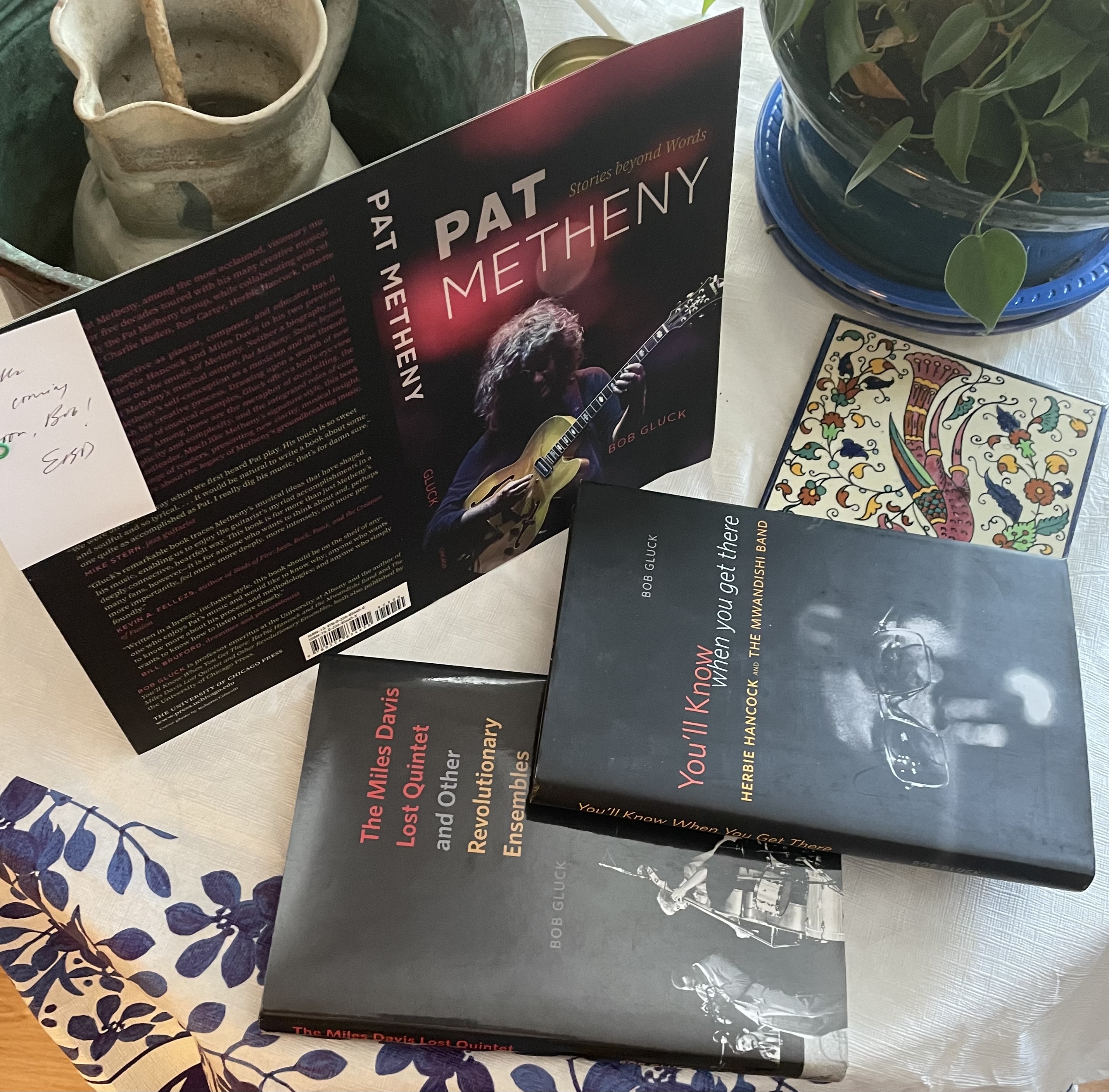
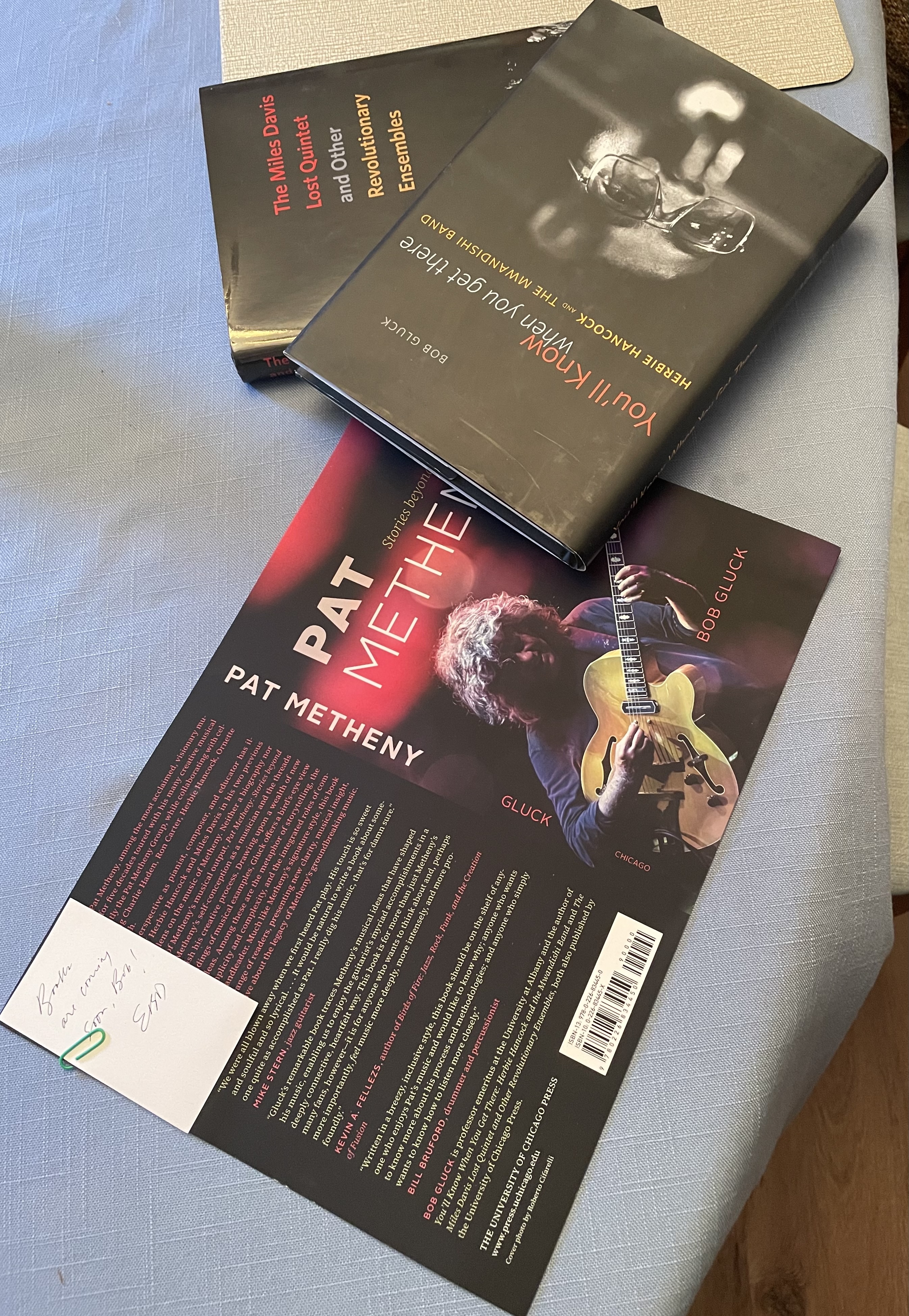
One of the exciting moments in the lead up to the release of a new book is when I receive a copy of the printed book jacket. I’ve known for a few months what the front cover would look like, but just on a computer screen. I had some idea of how the “blurbs” would read on the back cover, but not exactly. Actually seeing how it looks in the light, the depth of its colors… is a fun moment.

I kiddingly refer to these two pictures “the cousins” since both includes all three of my three University of Chicago Press books – “You’ll Known When You Get There: Herbie Hancock and the Mwandishi Band” (2012), “The Miles Davis Lost Quintet and Other Revolutionary Ensembles” (2016) and now, “Pat Metheny, Stories beyond Words” (coming August 5, 2024). Here they are! The cover photo on the new book is by Roberto Cifarelli.